

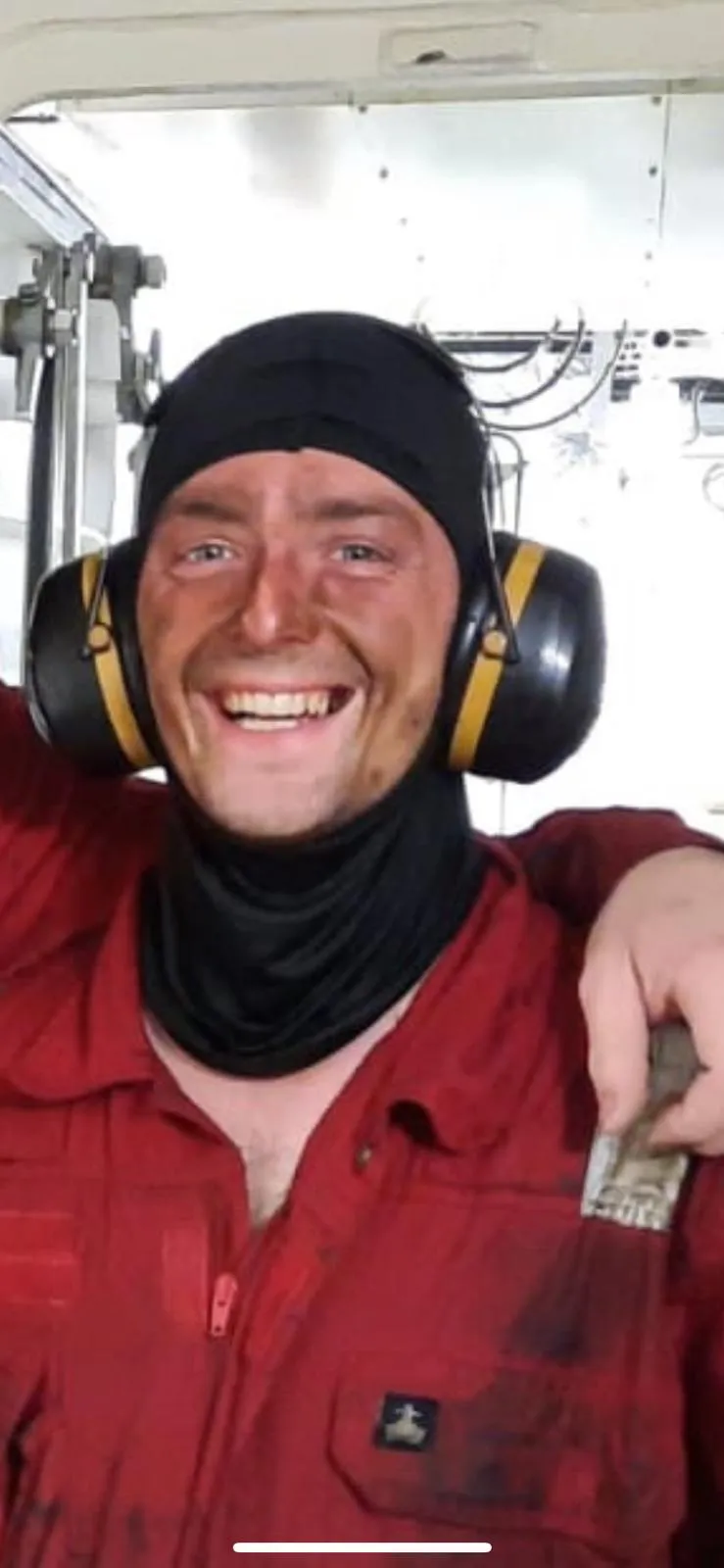
Oneshot exists because of one valve I forgot to close. It taught me that the know-how that keeps machines running lives in people’s heads, and that there is no backup when those people leave. Earlier this year I told that story at the Auki Grants program in Hong Kong. This is the written version, plus what I have learned since.
One valve, six tons of oil
I’m a maritime engineer. I worked on ships for a while, and to be honest, I wasn’t the best engineer on board. I was inexperienced and I made plenty of mistakes.
One of them: I forgot to close a valve. That one valve put six metric tons of oil into the bilge, the lowest part of the hull where leaks and water collect.
Cleaning it up took two weeks. The photo above is me at the end of it. I’m smiling, but trust me, I wasn’t happy.
There is no backup for what people know
Cleaning a bilge gives you a lot of time to think. What I kept coming back to: the valve wasn’t the real problem. The knowledge to avoid my mistake existed. It was in the heads of the people who had done that job a hundred times. It just wasn’t anywhere I could find it at the moment I needed it.
A ship is full of knowledge like that. Which valve sticks. Which pump sounds wrong a day before it fails. The order you really do things in, which is not always the order in the manual. This is tacit knowledge: what experienced people know, but rarely write down.
When a crew member rotates off, most of it leaves with them. Ships have handover systems, but much of what people know never makes it into them. There is no backup for human knowledge on board.
The bigger problem: people are retiring
Lost knowledge is only a problem when people leave. And a lot of people are about to leave.
Experienced workers are retiring faster than new people come in. In the US alone, Deloitte and The Manufacturing Institute estimate that manufacturers may need 3.8 million new workers between 2024 and 2033, and that 1.9 million of those jobs could go unfilled.
So knowledge transfer breaks at two scales. The small one is a handover between two people at the end of a shift or a rotation. The big one is a whole generation of experts leaving, with not enough people to take over what they know.
From a thesis on ships to a stage in Hong Kong
That idea stayed with me. I wrote my thesis on augmented reality for maintenance on board ships, then left the sea and worked at two XR startups. Then I started my own company.
Earlier this year I joined the Auki Grants program. Auki Labs is a Hong Kong company building the posemesh, a network that gives robots and AR devices a shared understanding of physical space. They asked me to tell the cohort in Hong Kong what I was building.
My talk was about smart glasses. AI models know a lot about the world in general, but almost nothing about your specific machine. So I built a way to give them that context. A QR code on the machine points an AI agent to everything known about it, from torque specs to alarm codes. You put on the glasses, look at the machine and ask.
With Auki, we built a voice guide that walks new operators through unboxing and starting up a Unitree G1 humanoid robot, so their team can get robots running faster.
What I have learned since
After Hong Kong I spent a lot of time with machine builders. The same story came back every time, and it was rarely about glasses.
Knowledge gets lost first in assembly. Companies hire people with zero experience. They outsource assembly to partners who have never seen the machine. And the one person who really knows how it goes together, the best assembler, is busy or close to retirement.
Work instructions are the weak spot. Writing them by hand takes days. They go out of date with the next design change. And they miss exactly the tricks that matter: the order that actually works, the bolt you tighten last, the part that only fits one way.
So this is what Oneshot does today:
- We build a 3D work instruction from your CAD file, step by step.
- Your engineers approve every step.
- Your best assembler adds what the CAD can’t show, with a quick video or photo.
- New hires and assembly partners follow it on a tablet, a phone or smart glasses.
For a humanoid robot torso, the work instruction took 30 minutes with Oneshot. By hand, it took 7 days. Read how we did it for Menlo Research.
What I would tell my younger self
If your team depends on a few experienced people, this is what I would do, with or without Oneshot:
- Capture it while they are still there. The cheapest moment to record know-how is before someone leaves, not after.
- Ask for the exceptions, not the procedure. “What goes wrong here?” gets you more than “How do you do this?”
- Record it where the work happens. A 20-second video at the workstation beats a long document nobody opens.
- Put it in the step where it’s needed. A tip only helps if it shows up right before someone makes the mistake.
- Keep it alive. Knowledge goes stale with every design change. Make updating it part of the job.
If my valve had come with one line, “close this before you open the next one”, shown at the right moment, I would have saved two weeks and six tons of oil.
Thanks to Auki for the grant, for the stage in Hong Kong, and for letting a maritime engineer talk about oil spills to a room full of robot people.